
Case Study: ROBOTEC.AI + ANALOG DEVICES – DIGITAL TWIN FOR SEMICONDUCTOR MANUFACTURING
Customer: Analog Devices
Challenge
Analog Devices (ADI) needed a way to validate new automation workflows within a complex semiconductor production bay. Traditional testing on the physical site is costly, slow, and disruptive to operations. Key challenges included:
- Building an accurate, interactive digital copy of the selected fab
- Integrating mobile manipulators into the simulation
- Modeling human–robot interactions safely, including emergency stop behavior
- Simulating lot handling processes from loading to unloading
- Providing outputs that help identify bottlenecks, idle times, and safety risks
Solution
Robotec.ai deployed its RoSi digital twin and simulation platform to deliver a customized simulation:
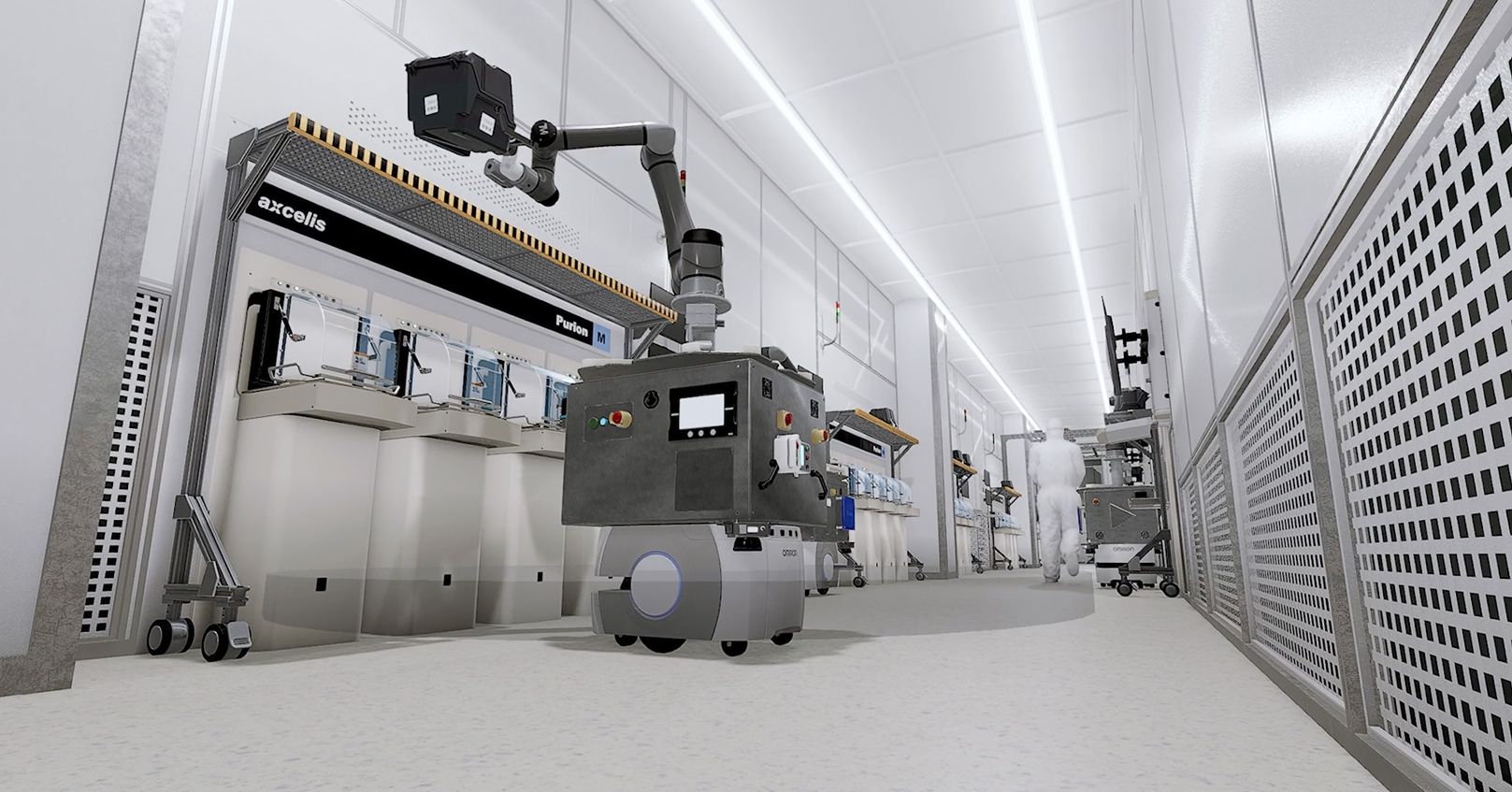
- Virtual Site Model: Created a high-fidelity digital twin of the fab from scans, CAD models, and videos, including load ports, stairs, storage, and equipment.
- Robots & Humans Simulation: Modeled mobile base with robotic arm and customized gripper, plus human agents in protective suits. Integrated realistic navigation, manipulation, and emergency-stop triggers.
- Process Simulation: Implemented full load–transport–unload–return cycles with collision detection, physics, and dynamic object interaction (chairs, shelves, lot boxes).
- Scenario Scripting: Developed real-world test scenarios for handling lots and interacting with workers.
- Outputs & Integration: Connected to query and execute navigation goals and manipulator programs, enabling system integration and testing.
Results
The provided solution for ADI with a scalable framework for digital transformation in manufacturing:
- Validated robotics workflows in a safe, virtual environment
- Identified process bottlenecks before real-world implementation
- Reduced costs by replacing expensive prototyping with simulation
- Improved safety through human–robot interaction modeling
This case study demonstrated the value of digital twin technology in semiconductor manufacturing and set the foundation for broader deployment at ADI sites.